
The Biology of the Bell
May 4, 2026 🥊 Why 3 Minutes Still Matters



When new clients train with me, they’re often caught off guard by the clock. They’re used to the "Fitness Math" of sets and reps: 3 sets of 10, rest, repeat. But in my gym, we work in intervals—two minutes, three minutes, one minute of recovery.
I tell them: In boxing, we aren't counting reps; we are training the signal.
Training for Time, Not Totals
Boxing requires neuromuscular endurance. Your brain needs to be trained to keep the neurons firing for the duration of a round, regardless of whether you’ve thrown 10 punches or 100. A "set" suggests a finish line where you can mentally shut off. A "round" requires you to stay "on"—reacting, moving, and breathing—without a predictable end until that bell rings.
The Evolution of the Round
A client asked me today: Where did the three-minute round even come from?
It’s an interesting piece of history. Before the mid-1800s, boxing was essentially a "go until you drop" sport. Under the old London Prize Ring Rules, a round only ended when a fighter was knocked down or thrown. Once a man hit the dirt, the round was over, and they would get a 30-second break to "come to scratch." This meant a round could last 30 seconds or 30 minutes—it was a war of total attrition.
In 1867, the Marquess of Queensberry Rules introduced the fixed 3-minute round. This was a massive shift. It moved boxing away from a "last man standing" brawl toward a sport of skill and pacing. Surprisingly, that 19th-century decision holds up under modern exercise science.
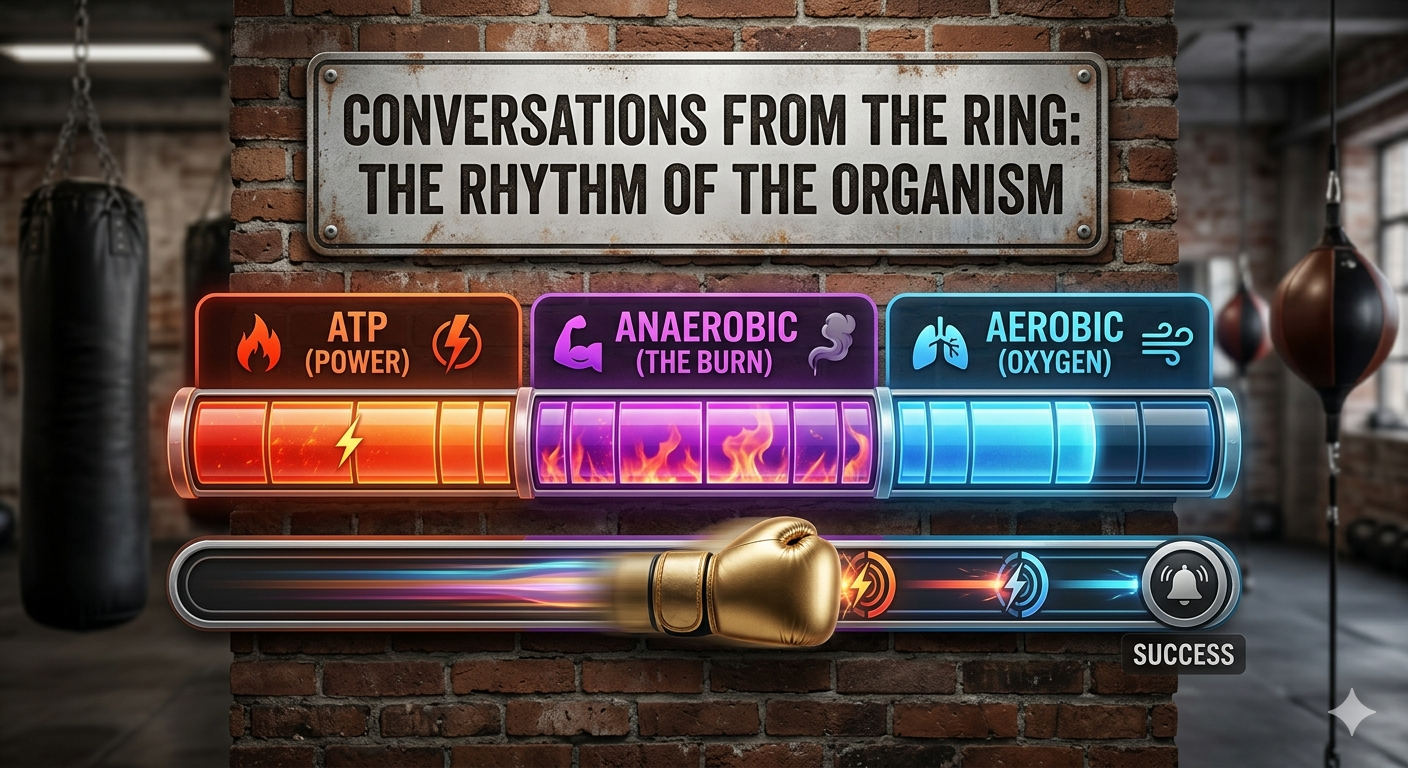
• ATP-CP System (Power): Lasts about 10–15 seconds. This is your explosive burst—the heavy hooks and power crosses.
• Anaerobic System (Lactic): Peaks around 30–90 seconds. This is "the burn." It’s the high-intensity work that makes your muscles scream as the byproduct builds up.
• Aerobic System (Oxygen): Kicks in fully after about 2 minutes. This is your recovery and long-term output.
A three-minute round forces you to cycle through all three. It is the prime window for peak human performance before total fatigue compromises your skill and safety.
The Arbitrary 7-Day Week
This sense of timing extends beyond the ring. In Torah study this weekend, we talked about the 6-day work week and the 1-day rest. Have you ever wondered why we use a 7-day week?
Months are based on the moon. Years are based on the sun. But the week is a human-made rhythm. The Babylonians started it, the Torah fixed it into a permanent cycle, and the Romans did eventually adopt it under Constantine, replacing their eight-day "market" cycle and spreading it across the globe. Whether it was to "hide from demons" or to rest like the Creator, humans realized early on that the body needs a specific cadence of output and recovery.
Is there science to back the 7-day week? Actually, yes. Biologists have found "circaseptan" (seven-day) rhythms in humans. Our blood pressure, heart rate, and even the rise and fall of certain hormones seem to follow a seven-day cycle that exists independently of our social calendars. Our bodies aren't just following a clock; they are a clock.
The Life Lesson: Respect the Rhythm
The body is an organism, not a machine. A machine doesn't care about time; it only cares about the task. But an organism understands rhythm.
We often try to live our lives in "sets of 10." We think if we just check off ten tasks, we’re done. But life doesn't happen in sets; it happens in rounds. Sometimes the "round" of a project or a difficult season lasts longer than we expected, and our "rep count" goes out the window.
The Lesson: Stop counting the reps and start mastering the interval. Whether you’re in a three-minute round or a seven-day week, success isn't about hitting a specific number—it's about training your brain to stay in the fight until the bell rings. Trust the rhythm of rest and work; it’s been wired into your biology for thousands of years.