
Forcing a Reaction
April 19, 2026 🥊 Honk the Horn



Every trainer teaches feinting. The goal is simple: make your opponent react. How? Feint! Just twitch your hand or slightly extend your lead hook, and bam—opponent fooled.
Except, it rarely works like that.
I’ve never been a "feint heavy" boxer. To me, feinting felt like a psychological Catch-22. If I didn't believe in the feint, my opponent wouldn't either. Because I was never sure it would work, I’d throw it tentatively, and—surprise—it never worked. A perfect self-fulfilling prophecy.
The Horn and the Scarecrow
So, how do you actually get someone to react? Think about the last time you crossed the street and someone unexpectedly honked their horn. You didn't "observe" the sound and decide to move; you jumped. It was loud, unpleasant, and in your face.
Or think about the classic Halloween scare: you walk up to a porch, and what you thought was a plastic decoration suddenly explodes forward. You’re cursed under your breath and jumped halfway into the bushes before you even realized it was a teenager in a mask.
You reacted because a still object became an aggressive threat in a split second. Your brain didn't have time to be "logical."
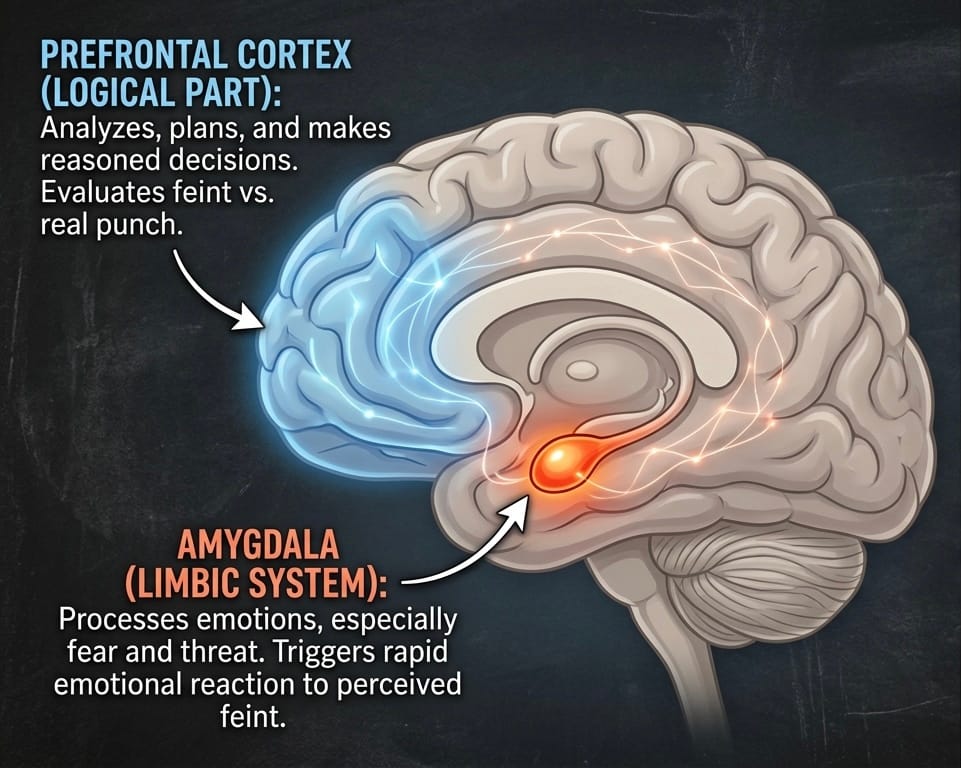
Bypassing the Logic
In the ring, a feint can’t be slight, slow, or eased into. If it’s tentative, your opponent’s logical brain stays in control. They see it for what it is: a fake.
To be effective, a feint has to be sudden, big, and dramatic. It has to bypass your opponent’s calm, observing state and hit their limbic system—the animal instinct part of the brain. You aren't trying to "convince" them you're punching; you are forcing their nervous system to enter a fight-or-flight state.
You don't have to "believe" in your feint. You just have to make their animal instinct believe it through pure surprise. When the threat is big and sudden enough, they stop thinking and start reacting—usually by doing exactly what they’ve been trained to do (like throwing a counter), which is exactly when you catch them.
The Life Lesson: The Power of the "Big Start"
We often approach big changes in our lives with the same "tentative feint" that fails in the ring. We "ease" into a new habit, or we "slightly" adjust our routine, hoping for a reaction from ourselves or the world. But because the move is so small and hesitant, our logical, lazy brain stays in control and talks us out of it.
The Lesson: If you want to break a plateau or change a dynamic, you can't be subtle. You have to "honk the horn."
If you want to start a project, don't just write a "to-do" list. Clear the whole table, buy the materials, and commit to a big, dramatic first step. You have to bypass your own logical excuses and force your system into a new state of action. Don't wait for "belief" to show up; create a movement so sudden and significant that your life has no choice but to react to it.