Punch as a Unit
May 18, 2026 🥊 Full Body Connection


Most of us spend the majority of our day living entirely in our upper bodies. Typing, texting, reading, scrolling, and talking—everything demands our heads and our hands. Western culture is fundamentally designed to disconnect us from the ground. We isolate our feet in stiff shoes, sit in chairs for hours, and navigate the world from the chest up.
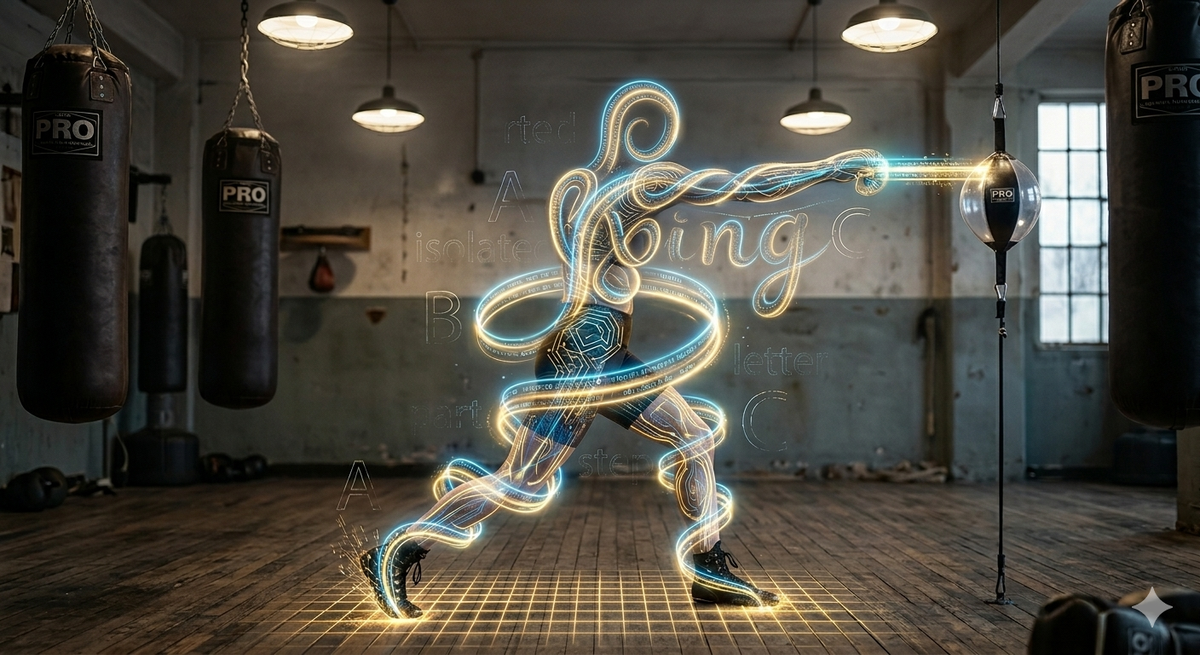
So, when I try to teach a full-body sport like boxing, I start with the mechanics: Rotate your whole body, from your foot to your shoulder. But because of how we live, that instruction usually gets translated into separate, rigid steps. A fighter rotates their foot, then their hips turn, and then the shoulder does a massive amount of work to force the arm forward.
We’ve hit A, B, and C. But I didn't want separate letters. I wanted a full word.
Isolated by Culture
Achieving a true full-body connection is incredibly difficult for most people without extensive practice. It’s not just a physical limitation; it’s a cultural habit. We isolate everything. We isolate body parts for daily tasks, we isolate muscle groups in traditional fitness, we isolate symptoms in medicine, and we isolate our emotions in therapy.
Be honest: how many of you actually think about what your toes are doing during the day?
True fighting demands that you stop thinking in fragments. It’s not just about moving as a mechanical unit; it’s about being intensely aware of what your entire organism is doing at every single moment.
The Extension of the Whole
In the ring, you have to know where your hands are at all times. You have to notice if you are hinging at your torso, how far apart your feet are, what your facial expression looks like, and how loudly you are breathing.
Boxing demands attention to your entire being, not just the knuckles. Your hands are merely an extension—an expression—of your body moving as a complete, unbroken whole. If you want that truly beautiful, effortless power in a punch, every single piece has to speak the same language at the exact same time.
The Life Lesson: Stop Living in Fragments
We treat our lives the exact same way we treat our movement. We compartmentalize ourselves. We treat our work life, our family life, our physical health, and our emotional state as separate boxes to check. We try to fix a problem at work by only looking at the "work box," or we try to fix our weight by only changing our diet.
We are constantly hitting A, B, and C, and wondering why our life feels disjointed and exhausting.
The Lesson: You cannot solve an internal alignment problem with a fragmented approach. Just like a powerful punch doesn't start in the shoulder, a powerful life shift doesn't happen in a vacuum. Everything is connected. How you show up in the kitchen affects how you show up in the office, which affects how you breathe under pressure.
Stop trying to move in separate letters. Start paying attention to your entire being—from the ground up. When you align the whole organism, the expression of your life becomes unified, fluid, and genuinely powerful.